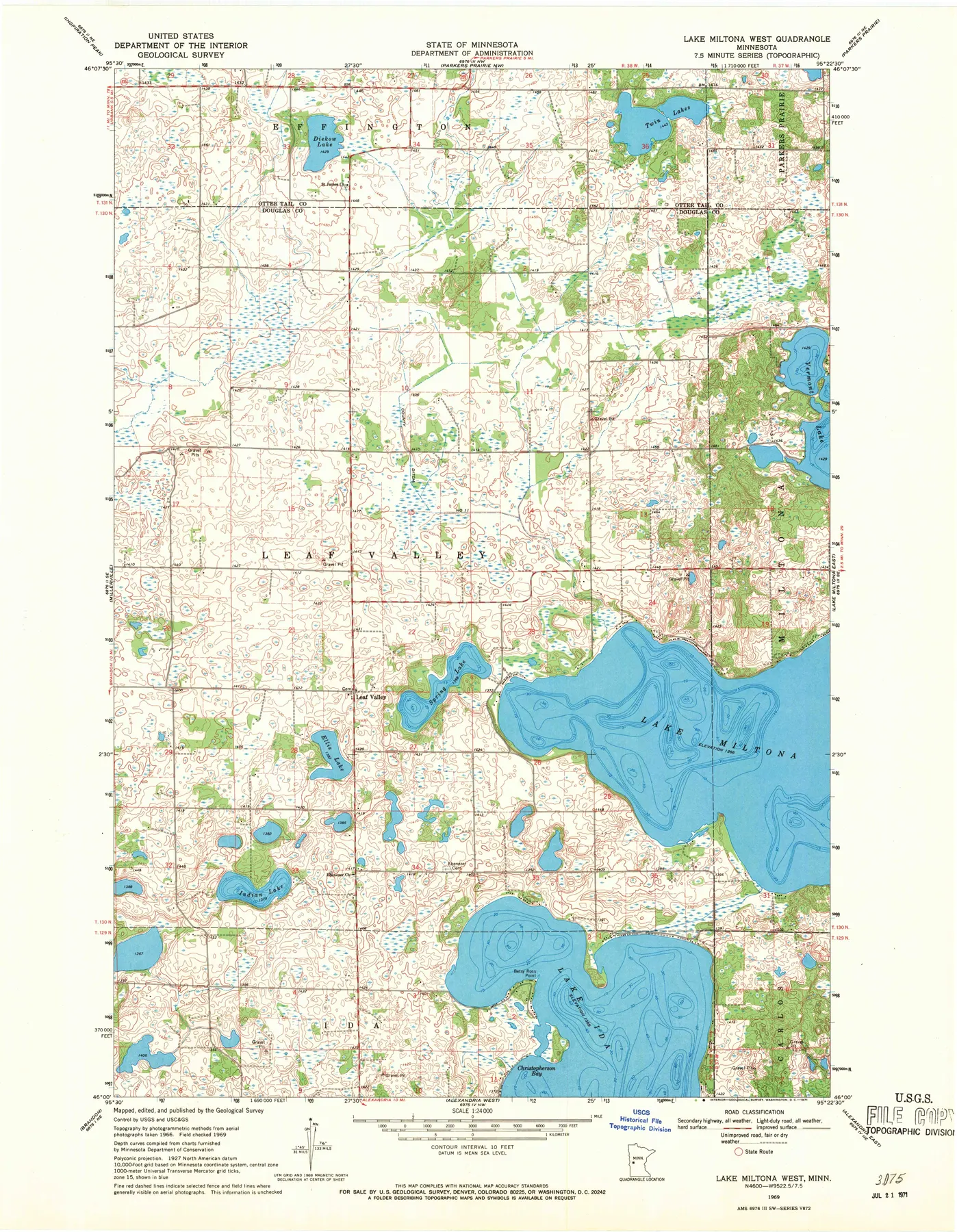
The clubs and resorts are mostly gone, but the lake never took their names off the signs.
Drive the roads around Lake Miltona and you are driving through a place that no longer exists.
Nobody planned it that way. Road names are practical things. Somebody has to call the gravel something so the mail gets through and the fire truck can find the dock. But around this lake, the names stuck to whatever stood at the end of the road when the sign went up, and a lot of what stood there is gone now. Read the street signs and you can still see it: the old lake, laid over the new one, one green sign at a time.
That is our observation, not a history claim. The documents do not say why each road got its name. But the names match the record too well to be an accident, and the record is worth reading sign by sign.
Minnesouri Club Road
Start with the oldest ghost on the map.
In 1890, twenty men from Missouri and fifteen from Minneapolis bought 40 acres on Lake Miltona and formed a fishing club, according to the Legacy of the Lakes Museum in Alexandria. They blended their two home states into one clumsy, perfect name: Minnesouri. Their charter promised "the instruction and mutual improvement in the art of angling," which is a formal way of saying they intended to get better at fishing and enjoy each other's company doing it.
The club never really left. It runs today as the Minnesouri Association of Cottages, still private, still members only, its clubhouse dating to 1890. Families there are into their fourth and fifth generations. So this sign is the honest one on the map. The name on the post and the place at the end of the road are still the same place.
Enjoy the sign for what it is, a piece of 1890 that never got renamed. Then keep driving. The club is private property, and the road is a landmark to read, not an invitation to visit.
Chicago Club Lane
The next sign points at a club that left almost nothing behind but its name.
An 1894 listing in the Alexandria Post News, the county's newspaper of record in those years, names "The Chicago Club, The Minnesouri Club, and At the Arlington" among the lake's early resort clubs. A National Register nomination for Alexandria says the same thing in drier language: by the turn of the century, exclusive private clubs stood on Lake Miltona, "including the Minnesouri and Chicago clubs." Men rode the train up from Chicago, fished all summer, and rode home.
After that, the paper trail thins to almost nothing. No founder list survives in print. No club history sits online waiting to be read. The Chicago Club is a name in two old documents and a lane on the township map, and that is the whole estate it left behind.
That is what makes the sign worth slowing down for. A lane is a small thing to inherit from a whole summer world of men, boats, and bass. But it is more than most lost places get.
Evergreen Lane
The Evergreen Inn belonged to the next wave, the one the automobile built.
After the First World War, cars got cheap enough for ordinary families, and resorts offering housekeeping cabins spread around Minnesota's lakes. A National Register nomination names the Evergreen Inn on Lake Miltona as one of them. The Douglas County Historical Society holds a photograph of its cottages from around the 1910s, and a postcard of its main lodge survives from the 1940s. Families kept buying the place and running it: one family's obituary records that they purchased the Evergreen Inn in 1946, and another family's son remembered his parents buying it when he was twelve, around 1949.
The inn itself is gone from the record. What is left is the lane, running down to the water with a resort's name on it and no resort at the end.
If the club roads remember rich men with trains to catch, Evergreen Lane remembers everybody else: the families who loaded a car, rented a cabin with a kitchenette, and cooked their own fish. That was most of lake life, most summers, for most people. It deserves its sign.
Sandy Beach Drive
The last sign is the one we know best, because our own address carries its name.
In 1962, Art and Fran Weller moved to Lake Miltona and bought Sandy Beach Resort, according to Fran Weller's obituary in the Echo Press. The resort stood on the north shore, on East Sandy Beach Drive NE: a lodge, some cabins, a beach that gave the place its name. They owned and operated it, part of the postwar generation of small family resorts that ringed this lake. The resort era faded the way it did on most Minnesota lakes, as families bought their own cabins and the little resorts sold off lot by lot.
The name stayed on the roads. Sandy Beach Drive runs on both ends of the lake, east and west, but they are different stretches of shore. The resort stood on the east road, on the north shore. West Sandy Beach Drive NW, the west road, is a different stretch altogether, not on or near the old resort land. What the west road shares with the resort is not ground. It is the name on the sign. Which means every visitor who drives in on West Sandy Beach Drive still drives the ghost map without knowing it. The turn off the county road, the sign at the corner, the gravel running down to the water: that is the resort era, still giving directions.
Reading the map
Six hundred some properties are platted around Lake Miltona today, and most of their owners could not tell you what a Minnesouri was. That is fine. The lake does not owe anybody a history lesson.
But the signs are still up, and they are free to read. A club from 1890. A club from Chicago that left one lane and two mentions in old paper. An inn from the first summers of the automobile. A family resort from 1962, on a road whose name visitors still drive in on. Four signs, four eras, one lake of 5,731 acres holding all of them at once.
Next time you drive in, read the signs like a table of contents. The chapters are mostly gone. The lake kept the titles.
Visiting the story
- The Minnesouri Club is private and members only. Read its sign from the public road and leave its summer alone.
- Alexandria's Legacy of the Lakes Museum holds the area's resort-era exhibits, including a re-created Minnesouri Club front porch.
- Sandy Beach Drive's east end carries a public boat access on the same water the clubs and resorts fished and swam.
- See it yourself: drive the loop slowly and read the signs like a table of contents, four eras on green posts around one lake.
Spot an error? Read our corrections policy.