Legends of the Lake
Miltona's Ghost TownsBefore Miltona had a name, the map here was already dotted with places that fed people, milled their grain, and caught their stage, and most of them are gone.
Arthur and William Merrical built the first flour mill and saw mill in this area, not in Miltona.
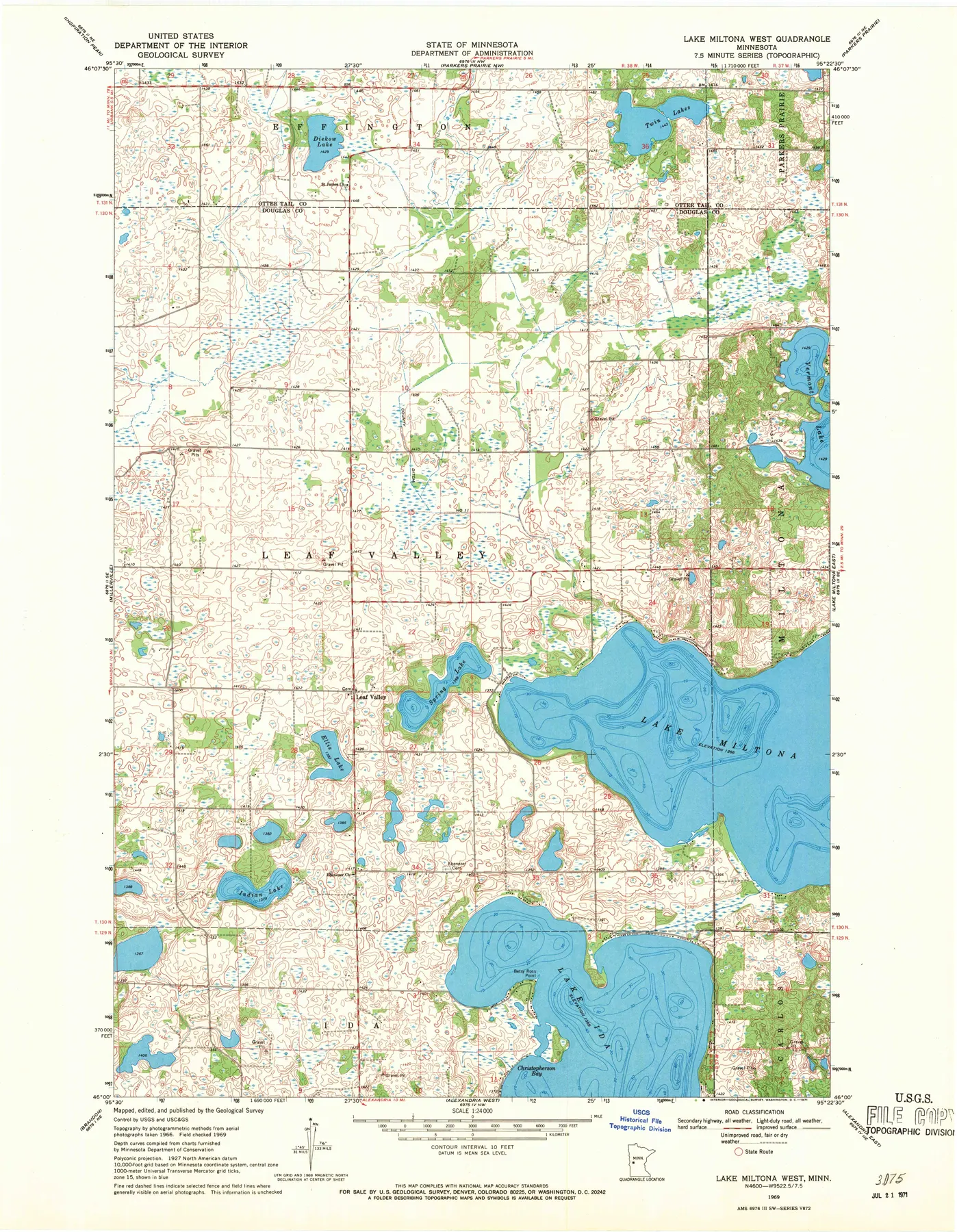
They built them at Spruce Center, a village north of Lake Miltona that most drivers now pass without knowing it was ever a village at all. Miltona, the town visitors know, is the youngest place around the lake, founded about thirty years after the hamlets in this story and not incorporated until 1930. Before it existed, farm families around the 5,731 acre lake, 105 feet deep and ringed by more than 15 miles of shoreline, did their business at a stage stop, a village now a county park, a creamery crossroads, and the Merrical brothers' mill town.
Alden: the stop on Boggy Creek
Alden is the oldest of the four, and the thinnest in the record.
The City of Miltona's compiled local history gives it one sentence: in 1870, Alden Hamlet, on Boggy Creek somewhere south of Lake Irene, was a stagecoach stop. That is nearly everything the published record says. No store list, no founder, no photograph has turned up in the sources we have found, and this series will not invent them.
What can be said is the world Alden belonged to. In 1870 this was stage country. J. C. Burbank and Company of St. Cloud was the stage line of the era, running coaches on the St. Cloud to Fort Abercrombie road from 1859 until about 1874, carrying mail and passengers through a county the railroad had not yet reached. A stop on a creek meant a place to change or rest horses and hand off mail.
What killed Alden is written in the dates around it. Burbank's stage era ended about 1874 as the railroad pushed west, and the first train reached Alexandria on November 5, 1878. Traffic that had moved at horse speed past Boggy Creek moved to the rails, and a stop whose whole job was serving the road had no second job. No source we found records Alden's last year or a single building left standing. What is left is the country itself: Boggy Creek running south of Lake Irene, in the same low ground the stages crossed. For the feel of that era in a building you can walk into, the Miltona Stage Coach Stop now stands at Fort Alexandria in Alexandria. It is a Miltona stage building, not a documented Alden building, and we label it that way.
Spruce Hill Village: the town inside the park
Ten years after Alden, around 1880, Spruce Hill Village was founded, and this one the record describes like a real town.
The Miltona history lists three stores, a blacksmith shop, a mill, and a post office, with the old Military Road nearby. The fuller account carried in our Spruce Hill Park story adds a schoolhouse, a sawmill, a hotel, and a saloon. The 1916 county history counted Spruce Hill as one of the two hamlets of Spruce Hill Township, organized on March 9, 1875. This was no wide place in the road. It was the service center for the farm families settling the timbered hills.
No source we found names a single event that killed it, and we will not pick one for drama. What the record shows is the same shift that emptied Alden, one generation later. The Soo Line, the Minneapolis, St. Paul and Sault Ste. Marie Railway, came through Douglas County in 1902 and built its stations at Forada, Carlos, and Miltona. No station came to Spruce Hill, and the village faded while the new railroad town grew up. It died of being bypassed, slowly.
What is left is the best of the four, because the county kept the ground. Spruce Hill Park, 87 acres of county parkland, stands where the village stood. Trails and interpretive signs mark the townsite, and you can still stand by what is left of the school foundation. The schoolhouse itself survived by moving: it stands about a mile north, in a new metal roof and siding, working as a township hall. Just southeast of the park, the Swedish Lutheran church still stands, its congregation founded by Swedish immigrants in 1876. Our Spruce Hill Park story tells the creek and the trails in full.
Rose City: the creamery crossroads
Three miles from Spruce Center, by the Miltona history's measure, a creamery and a general store were built at the crossroads called Rose City.
A creamery was serious infrastructure in farm country. It gave every dairy farm within wagon distance a weekly reason to come to one corner, sell cream, and do the rest of the week's business at the store on the same trip. The local history adds one older layer, plainly: the creamery was built on an old Native campsite.
Rose City is the ghost town that only half qualifies, and our Rose City town guide tells its present tense in full, so this piece keeps to the arc. The creamery is gone, and so is the general store. No source we found says when the creamery closed or why, so the familiar story of creamery consolidation stays a general pattern, not a claim we print about this building. What is documented is the bypass: the Soo Line's 1902 stations went to Forada, Carlos, and Miltona, and Rose City watched the growth happen a few miles away. Unlike Spruce Hill, Rose City never emptied. The name, the church, and the crossroads held, and today a bar and grill anchors the corner and a threshing festival fills the grounds one weekend every July. See our Rose City MN town guide for the bar and the Threshing Bee.
Spruce Center: the mill town that shrank instead of vanishing
North of Spruce Hill Village stood its twin: the Village of Spruce Center also had three stores, a blacksmith, and a mill.
Spruce Center had one distinction its twin did not. Arthur and William Merrical built the first flour mill and saw mill in the area there, a fact carried in the St. Nicholas parish history at Belle River, compiled from the parish's 1970 centennial directory. Flour and lumber were the two things a new farm could not make for itself, and the Merricals' mills gave every settler family a reason to come. The name is plain geography: Warren Upham's Minnesota Geographic Names (Minnesota Historical Society, 1920) says Spruce Center was named for its location within Spruce Hill Township.
It also lasted longer as a working place than a ghost town is supposed to. Well into the resort era, Smitty of Smitty's Hur-E-Bac on Lake Irene got his bait from Spruce Center, according to his family's account published by the Lake Irene Preservation Association. A place still supplying a resort's bait tanks is not a ruin.
Spruce Center never got a railroad either. It shrank to fit the farm country around it: today, by the Miltona history's exact present tense, a cluster of homes and a few businesses make up Spruce Center. The stores, the blacksmith, and the Merricals' mills are gone from the record, and no source we found dates their closing. Rhonda Fochs counted both Spruce Center and Spruce Hill among Douglas County's lost towns in Minnesota's Lost Towns, Northern Edition, and Spruce Center is the one on her list you can still drive into and find people home.
Four places, one lesson
Read the four together and the lake country stops looking inevitable. Alden died when the stage did. Spruce Hill Village faded when the railroad chose other ground. Rose City lost its creamery and kept its name, its church, and its corner. Spruce Center lost its mills and kept its people. Miltona, the latecomer with the depot, got the century. None of these places failed at being towns. The roads and rails simply moved.
See it yourself: start at Spruce Hill Park, where the county has marked the village ground and the school foundation still shows, then drive north through the Rose City crossroads to Spruce Center, and finish along Boggy Creek south of Lake Irene, where Alden's stage stop stood in 1870 and nothing marks it at all. The quiet there is the truest monument any of the four has.
Spot an error? Read our corrections policy.