She sewed her first shirt at eight years old in a town of fewer than a hundred people, and she grew up to stitch the first quilt block ever made in orbit.
Three small towns share Karen Nyberg, and the record is plain about which one gets which part. NASA's biography gives her birthplace as Parkers Prairie, where she was born on October 7, 1969. The same biography lists her hometown as Vining, a village of fewer than a hundred people, and that is the word NASA has used for her ever since. Her high school diploma came from a third town, Henning, in 1988. Parkers Prairie got the birth. Vining got the growing up. Henning got the graduation. Anyone who tells you one town owns her whole story is skipping two thirds of it.
Vining is where her parents, Kenneth and Phyllis Nyberg, still live, per NASA's biography. It is also where her father built the town's second claim on her. Ken Nyberg spent his working life as a welder and construction foreman, and he makes giant sculptures out of scrap metal. His work fills Nyberg Sculpture Park in Vining, next to the Big Foot Gas and Grocery: a 1,240 pound iron foot he worked on in secret for over two years, a floating cup of coffee caught mid-pour, pliers big enough to need their own zip code. When his daughter flew to space in 2008, he welded her a steel astronaut and set it front and center in the park, life size, in a field of giants. The Land, a Minnesota farm paper, noted that he also made a little green space being and set it looking at her. That is a father's press release, and it is better than any NASA ever wrote.
The daughter earned the sculpture. Nyberg has said that about the same time she looked up at the sky and knew she wanted to be an astronaut, she sewed her first shirt, at age eight. She took the long road through engineering: a mechanical engineering degree from the University of North Dakota in 1994, summa cum laude, then a master's in 1996 and a doctorate in 1998 from the University of Texas at Austin. Her graduate research studied how the human body regulates heat, work aimed squarely at keeping people comfortable inside spacesuits. She started at NASA's Johnson Space Center as a co-op student in 1991, earned a patent for work on a robot friendly probe and socket assembly, and joined the Crew and Thermal Systems Division in 1998. NASA selected her as an astronaut in July 2000.
Her first flight came on May 31, 2008, aboard the shuttle Discovery. STS-124 delivered the pressurized module of Japan's Kibo laboratory and its robotic arm system to the International Space Station, and Nyberg operated the robotic arms on the mission. The flight made her the 50th woman in space. She went back up on May 28, 2013, riding a Russian Soyuz from Baikonur with cosmonaut Fyodor Yurchikhin and European astronaut Luca Parmitano. That stay lasted 166 days. On June 16, 2013, the fiftieth anniversary of Valentina Tereshkova's first flight by a woman, Nyberg was one of only two women in space anywhere on Earth. Across her two missions she logged 180 days in orbit.
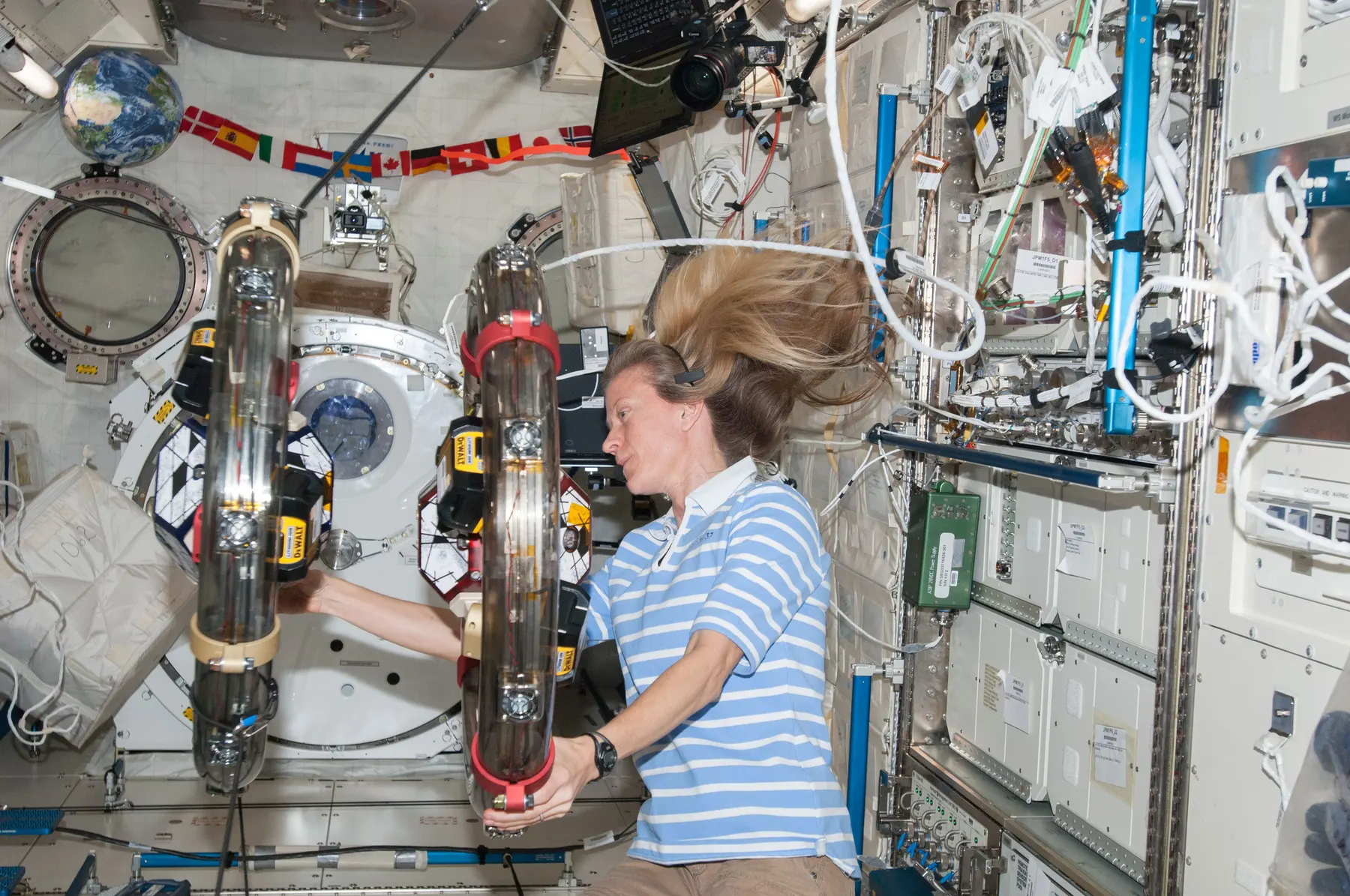
Ask people what they remember about the 2013 flight and most of them skip the hundreds of experiments. They remember the sewing. Nyberg had been sewing her whole life, and she carried the habit to orbit with a spool of ivory thread, five needles, and three fat quarters of fabric. Scissors and rotary cutters did not make the trip. In September 2013 she showed the world a small stuffed dinosaur she had stitched for her young son out of the fabric linings of Russian space food containers, believed to be the first stuffed animal handcrafted in space. Then, in a video NASA released on October 30, she held up a nine inch star themed quilt block in red, white, and blue that she had pieced together in weightlessness. "It is far from being a masterpiece," she said. "I've discovered several challenges with cutting and piecing and stitching in weightlessness." She was, as far as anyone can establish, the first person ever to quilt in space.
She invited Earth's quilters to make star blocks of their own, and they answered with 2,400 blocks from more than 30 countries. Volunteers at Johnson Space Center sewed them into 28 king size quilts, hers in the middle of it all, and the quilts went on display at the International Quilt Festival in Houston in 2014. The collection now lives at the Briscoe Center for American History at the University of Texas at Austin. Her other famous broadcast from that mission had nothing to do with fabric. Her video showing how she washed her hair in orbit went around the world, the rare space lesson every person on the ground understood instantly.
Nyberg later served as chief of NASA's Robotics branch and retired from the agency in March 2020, after nearly thirty years that started with a student co-op job. She received the NASA Distinguished Service Medal, the agency's highest honor for its own people. Retirement did not end the quilting. In 2022 she launched a fabric line called Earth Views with Robert Kaufman Fabrics, the fabric house whose Kona Cotton solids fill quilt shop shelves, built from 13 photographs she took of the planet from the space station: ocean currents, forests, and coastlines she had looked down on from orbit, printed on cloth for other people's quilts.
There is a clean symmetry to it that nobody had to invent. A girl from Vining learned to make things with her hands, at a kitchen table in a town too small for a stoplight. She grew up and made things with her hands for a living, first spacesuit cooling, then an orbiting laboratory, then a quilt block floating in front of a camera while the Earth turned underneath her. Her father's steel astronaut still stands in the park back home, watching the highway. She spent 180 days above that highway. Both of them, in their own materials, built the same tribute to the same small place.
Visiting the story
- NASA lists Karen Nyberg's hometown as Vining, Minnesota. She was born in Parkers Prairie and graduated from Henning Public High School in 1988, so all three towns on the drive have a piece of the story.
- Nyberg Sculpture Park in Vining holds the life size steel astronaut her father welded after her 2008 flight, standing among his oversized scrap metal sculptures next to Big Foot Gas and Grocery.
- Her star quilt block and the 28 quilts it inspired are preserved at the Briscoe Center for American History in Austin, Texas. Her Earth Views fabric line, drawn from photographs she took in orbit, is still sold for quilters.
Spot an error? Read our corrections policy.