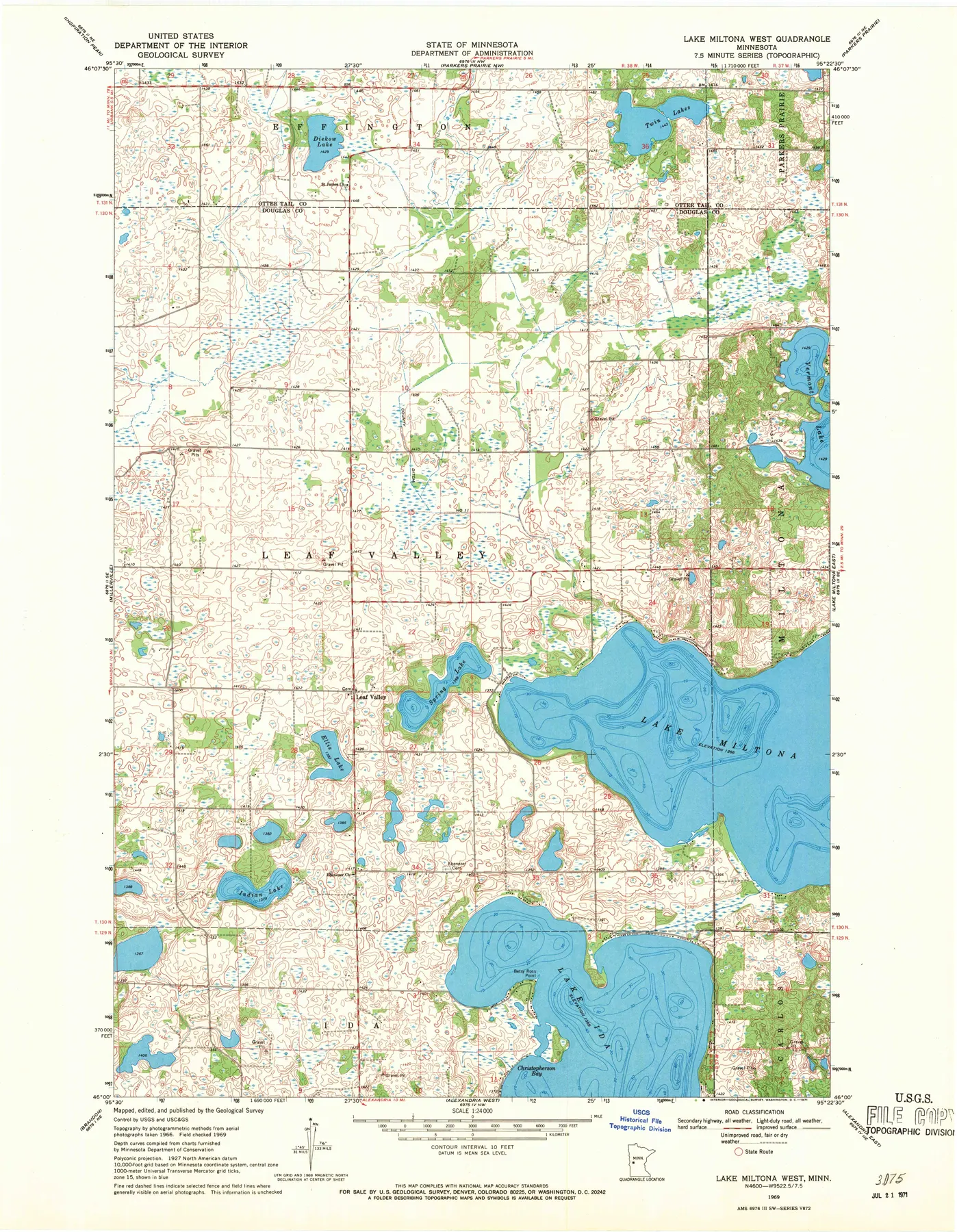
Before the resorts and the summer homes, Lake Miltona waited at the far end of the survey map, its shore divided into squares that decided who could come and who had to wait.
Lake Miltona was not built all at once.
It was surveyed, parceled, reached by train, reached again by automobile, wired for electricity, crowded with resorts, divided into lots, and edged with private homes. The lake's oldest known log cabin no longer stands beside the water. It stands in a museum in Alexandria. The shoreline looks inevitable now. It was not.
The last squares on the map
Douglas County's federal survey began in 1857. The U.S. General Land Office finished subdividing the last of the county's 20 townships in 1871, according to Douglas County Public Works. Lake Miltona sat across two survey townships. The Leaf Valley side, Township 130 North, Range 38 West, was platted in 1867. Miltona Township, Range 37 West and the main body of the lake, followed in 1871.
That delay mattered. A survey turned land into sections that could be claimed, bought, sold, taxed, and recorded. The Roadruck family reached Leaf Valley Township in 1866 or 1867, just as its survey was completed. Around the main body of Lake Miltona, the legal map arrived later.
Then the railroad took its share.
When Miltona Township was established on December 19, 1871, its odd numbered sections belonged to the St. Paul and Pacific Railway Company, the line whose federal land grant, every odd section along its route, was its payment for building the road. The even numbered sections were mostly taken through homestead entries, the 1916 county history records. On a map, the result was a checkerboard. A settler might claim one square while the railroad held the next. Along a shoreline, that pattern could leave good frontage locked inside a large railroad holding while farms filled in around it.
The railroad still held Sections 28, 29, and 33 in 1903, according to the township land record compiled from the Douglas County Recorder's Office. First recorded owners elsewhere appeared gradually between 1871 and 1893. The lake was opened in pieces, which is why wealthy fishermen arriving in the 1880s and 1890s found woods, fish, and room to build a private world instead of a shore already crowded with hotels.
First wave: the train brought the clubs
On November 5, 1878, the first St. Paul, Minneapolis and Manitoba train reached Alexandria. The railroad later became part of the Great Northern system, James J. Hill's northern transcontinental, which made Alexandria a stop on a through route between St. Paul and the Pacific Northwest instead of the end of a branch. The 1916 county history called its arrival an occasion of general rejoicing. For Lake Miltona, it changed the meaning of distance.
Visitors still had to cover the last miles north of town over land, but Alexandria was now tied to the Twin Cities and the wider Midwest. Men with money could ride north, fish hard, and return with stories big enough to recruit the next party.
The club era followed. The Monmouth Club came first, followed by the Minnesouri Club in 1890 and the Chicago and Miltona clubs in the same broad period. The National Register nomination for Alexandria's historic district notes that by the turn of the century, several exclusive private clubs had been established, including the Minnesouri and Chicago clubs on Lake Miltona.
These were not public resorts in the later sense. Members bought shore, built clubhouses and cottages, and returned year after year. A club could transform one bend while the rest of the lake stayed comparatively quiet.
A building from this first age survives in an unexpected place. A log cabin built on the northeast side of Lake Miltona around 1898, later associated with Douglas Ostlund, was described by the Echo Press as believed to be the longest lived in log cabin in Douglas County. It was taken down piece by piece and restored at the Runestone Museum.
The Soo Line, the Minneapolis, St. Paul and Sault Ste. Marie Railway and the second railroad through the county, entered Miltona Township in 1902 and put a depot in Miltona village itself in 1912, a short wagon ride from the lake's south end. But the next great change arrived on rubber tires.
Second wave: the automobile brought the resorts
By 1916, the county history could already describe the new pattern. Douglas County's lakes brought thousands of summer tourists, and, in its words, "most of these come in by automobile," with license plates noted from Oregon to Florida and New York to Texas.
A train passenger belonged to a timetable and a depot. A driver could bring the whole family, pack food and bedding, and stop at the lake that looked right. After World War I, when automobiles became more affordable to the middle class, resorts offering housekeeping cabins spread across the region. The National Register nomination names the Evergreen Inn on Lake Miltona among them.
A housekeeping cabin was practical. The resort supplied the shore, boat, cabin, and perhaps a lodge. Guests cooked and settled in for a week. It was less grand than a private club and far more accessible.
Photographs place Ideal Beach in that world by 1925. The Minnesota Historical Society holds images of its shore and main lodge dated to that year. The research does not establish an earlier founding date.
The Chain Cottage tells the era from the inside. A. B. "Burt" Chain built it in 1926. The Echo Press account of its centennial says the cottage began up on stilts without a porch. One family kept it for 100 years, but running water and electricity did not reach it until a 1960s update by Marvin and Virginia Schmid.
That was no hardship by the standards of the time. A cabin was a shelter between the dock and the table, and the lake did the entertaining.
Power came in 1937, but not everywhere at once
Douglas County's electric cooperative was organized in 1935, during the first years of the federal Rural Electrification Administration. Construction began on its first line on June 1, 1937. The line served 45 farms, including Senator Henrik Shipstead's cabin on nearby Lake Irene, and power reached those farms that September.
One correction belongs here because local stories grow in the retelling. Douglas County's system was Minnesota's second REA financed cooperative, not its first. The distinction does not make the moment smaller. The cooperative built 56 miles of line that year and began replacing the old division between town comfort and lake improvisation.
Electric light stretched the evening, refrigeration changed the food, and pumps changed the water. But the Chain Cottage waited until the 1960s. Development moved property by property and dollar by dollar.
Third wave: the private lake home
After 1950, the center of gravity shifted again. Minnesota's seasonal lakeshore homes rose from roughly 43,000 in 1950 to about 73,000 in 1960, a 70 percent increase reported in the DNR's shoreland history. Better roads, ordinary cars, and more paid vacations let a family buy a lot and build its own place instead of renting a resort cabin.
Older resorts still mattered. Art and Fran Weller bought Sandy Beach Resort in 1962 and moved to Lake Miltona to own and operate it, according to Frances Weller's obituary. Around the resorts, though, platted lots and individually owned cabins were becoming the dominant form.
The DNR's history describes the pattern plainly. Small seasonal cabins under 1,000 square feet were common in the 1960s and 1970s, and many homes and cabins were built on small lots close to the water. You can still read that period from a boat. The postwar cabin was not designed to impress the lake. It was designed to get a family as close to it as the lot allowed.
That closeness forced a public answer. Minnesota passed its Shoreland Management Act in 1969. In 1970, the DNR adopted county shoreland rules for lake classifications, lot sizes, and setbacks. Lake Miltona is classified for general development, but that did not mean no rules. The rules changed the terms on which the lake would be built.
What the building made
The Lake Miltona Association now counts just over 600 properties platted around the lake. That number is the end of the story the survey began. It is the accumulated result of railroad sections, homesteads, private clubs, resort cabins, family cottages, subdivision plats, electric lines, roads, and rules.
Some of the record is still easy to see. The Minnesouri Association of Cottages carries the club era forward, the Ostlund cabin stands at the Runestone Museum, and old names remain attached to roads and neighborhoods after the businesses that inspired them have vanished.
That is how a lake gets built. Not by one founder and not in one boom. It gets built every time a new way of reaching it puts a different kind of person on the shore. The train brought the clubs. The automobile brought the resorts. The postwar road and paycheck brought the private cabin. Electricity made each version easier to keep, and the 1969 rules finally admitted that the shoreline itself had limits.
The water did not change its job through any of it. At the end of a summer day, it still takes the light the same way it did when the survey crews were late, the railroad held every other section, and the first city fishermen were trying to explain why this lake was worth the trip.
Visiting the story
- The Ostlund log cabin from Lake Miltona's northeast shore, dating to about 1898, now stands at the Runestone Museum in Alexandria.
- Lake Miltona's public accesses put you on the same 5,731 acres the clubs, resorts, and cottage families built around.
- See it yourself: ride the lake by boat or drive its shore roads and read the layers in order, club bends, resort names on the road signs, and postwar lots in between.
Spot an error? Read our corrections policy.