Legends of the Lake
History of Lake Miltona's ClubsFor 56 years Herman Engfer kept one club running on this lake, while the men who founded the clubs came and went by train.
Herman Engfer was born in Carlos Township in 1880, close enough to Lake Miltona to spend his working life on its west end. His memorial gives him one job and one number: caretaker of the Minnesouri Angling Club for 56 years. He guided there too. His daughter Madeline grew up at the club, and another daughter, Pauline, worked there young.
Engfer did not found anything. He kept a founded thing alive. That is the right place to start, because the lake's clubs left uneven records. One left a charter and a clubhouse that still stands. One left a catch log scientists used sixty years later. Others left a name in a newspaper and a lane on a map. The local people who rowed, cooked, and cleaned for them left the longest record of all, in years of service instead of paper.
The first name on the water
The Douglas County Historical Society puts the Monmouth Club first, before the Minnesouri and before 1890. This series uses two forms of its name, Monmouth Club and Monmouth-Miltona Fishing Club, for the same body. Its members likely came from Monmouth, Illinois, though that link rests on the name alone.
What the Monmouth left was a log. From 1894 to 1897, fifteen members wrote down what they caught, fishing mostly on Miltona, Ida, and Spring Lake. The notes describe them as expert fishermen who preferred largemouth and smallmouth bass. In 1955, fisheries scientist John B. Moyle drew on that log for "Sport-Fishing Trends in Minnesota," in The Progressive Fish-Culturist. A vacation club's fishing record became evidence for what these lakes held before modern management. No named guide for the Monmouth survives in these sources.
The judge's club
The next club has the one founder this series prints, because the published record already names him.
Judge Lorin C. Collins grew up near St. Paul, became Speaker of the Illinois House in 1883, and later sat as a judge of the Cook County Circuit Court in Chicago. A Chicago Republican directory published in 1900 lists among his memberships the "Miltona Club, which he founded twelve years ago." Twelve years before 1900 is about 1888, before the Minnesouri was incorporated. The historical society describes the Miltona Club as a club of men from Illinois. Its president in the early 1890s was George M. Moulton of Chicago, a former Grand Commander of the Illinois Knights Templar.
The trains made such clubs possible. The St. Paul, Minneapolis and Manitoba Railway, later part of the Great Northern system, reached Alexandria on November 5, 1878, and the club era followed. How members covered the last eleven miles to the lake is not documented in these sources.
The Miltona Club's best remembered member may be Colonel VanCleave of Springfield, Illinois. The record kept his rank and hometown, lost his first name, and kept his plan: channels cut from Lake Miltona into the Chain of Lakes around Alexandria, so residents could shop by boat instead of by horse drawn vehicle. The channels were never dug.
The club that lasted
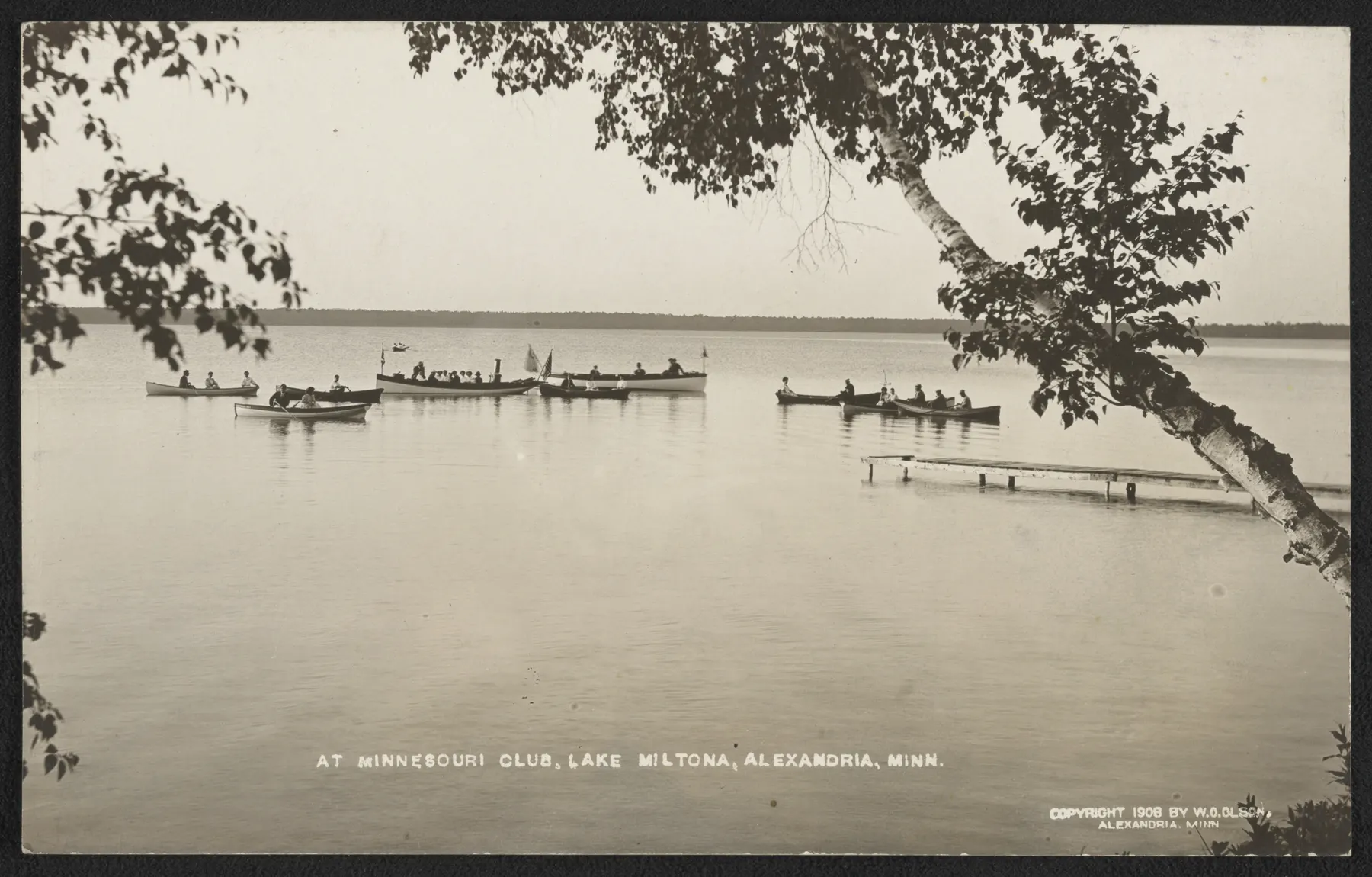
The Minnesouri Angling Club began, as the Legacy of the Lakes Museum in Alexandria tells it, with Minnesota men inviting friends from Kansas City, Missouri, north in the 1880s. In 1890 they made it formal. Twenty men from Missouri and fifteen from Minneapolis bought 40 acres and incorporated a club, blending their home states into one name: Minnesouri. Their charter set the purpose as "the instruction and mutual improvement in the art of angling and the social culture and entertainment of its members." No founder list for the Minnesouri is published in these sources, and none is printed here.
This was a summer institution, not a weekend camp. Miltona Township farmer Gilbert Thompson, quoted in the historical society's lake history, counted more than a hundred visitors at the clubs staying three months and spending thousands with local merchants. His reason was plain: if it were not for the fish, they would not come.
At supper the camp turned formal. Kori, who sang and played keyboards at the Minnesouri dinner hour, remembers the adults in formal black and white dining attire (DCHS post comments, Aug 2023). The days were rowboats and bass. The evenings were a dining room.
Those rowboats were the era's standard craft. In Alexandria, Erick Erickson's Alexandria Boat Works built wooden rowboats from 1885 onward, 15,250 boats by 1952, sold under its Lady of the Lakes name. The works built the kind of boat the clubs used. No source here states that it supplied the Minnesouri fleet, so this piece does not claim that link.
A kingdom, and the names around it
The City of Miltona's history records that the Minnesouri and Illinois Fishing Clubs dubbed Lake Miltona "the Bass Kingdom of the United States." Bass were the fish of the club era. The lake's walleye fame came later.
That sentence also creates a tangle this piece leaves open. The research cannot confirm the Illinois Fishing Club as a separate organization. It may have been the Miltona or Chicago Club described by home state instead of formal name. No charter record for it was found.
The Chicago Club is firmer, but only just. An 1894 listing in the Alexandria Post News, Alexandria's newspaper of record for the era, names "The Chicago Club, The Minnesouri Club, and At the Arlington" among the early resort clubs. A National Register nomination also names the Minnesouri and Chicago clubs as private clubs on the lake by 1900. After that the trail thins to Chicago Club Lane on the township map. Whether the Chicago Club was the same body as the Miltona Club under another name is unverified. Both names stay here because both are in the record.
The last name is the thinnest. The historical society and the city history preserve a Minnesota Angling Club from the period. The research found one officer: Dr. William L. Campbell, "secretary and treasurer of the Minnesota Angling Club at Alexandria, Minn.," who died at Miltona on July 26, 1933. No founding date, acreage, or clubhouse location survives in these sources.
The people who made the summers work
At the Minnesouri, members rotated with the seasons. The staff did not. Alfred Schulke, born in 1899, was employed by the club as a fishing guide for 59 years, longer even than Engfer. His memorial calls him a fishing guide and sportsman, in his family's own words. No source here gives a start year for either man.
Gene Hagedorn guided there too, and his wife Lydia worked as a housekeeper. Their granddaughter Cheryl (DCHS post comment, Jul 2026) remembers that after the fishing he cleaned the clients' catch and cooked it for them over an open fire, in a huge frying pan the family still keeps. That detail is one family's memory, printed as her telling.
Around them stood a crew whose names survive in comments under historical society photographs from August 2023: Edna Berglund, a first grade teacher in Alexandria who served as dining room hostess; Wilbert and his son Bob, who kept the club's wiring; and Pat, who waitressed in 1968 and 1969. Gregg, in the same thread, summed up membership in one line: "You had to be born into that club." The staff were the opposite of that rule. Local families took the work, and the longest serving kept it for a lifetime.
Member families lasted in their own way. Published obituaries describe cottages held for more than a hundred years and membership now in the fourth and fifth generations.
What the era left
Of all these clubs, only the Minnesouri clearly survives, today as the Minnesouri Association of Cottages, still private, its clubhouse dating to 1890, with more than a hundred members. The Monmouth left a log. The Miltona Club left a directory line and an undug canal plan. The Chicago Club left a listing and a lane. The Illinois Fishing Club left a title and an open question. The Minnesota Angling Club left a name and one officer.
The lake they all came for is public now, all 5,731 acres of it. On a June evening the light still goes long over the shallows the club men fished, and anybody with a license and a boat can cast into water that private clubs once treated as their own summer country.
See it yourself
- The Minnesouri Club is private. Read it from the water, and its name on Minnesouri Club Road from the public road.
- Chicago Club Lane is the Chicago Club's clearest surviving trace.
- The Legacy of the Lakes Museum in Alexandria holds a re-created Minnesouri Club front porch.
- Lake Miltona's public accesses put you on the same water all of these clubs fished.
Spot an error? Read our corrections policy.