Legends of the Lake
Four Generations at the MACA caretaker raised his daughter inside its gates, a guide's grandchildren still tell his stories, and one family's cottage has stood at the club for more than a hundred years.
Herman Engfer gave the Minnesouri Angling Club 56 years of his life.
He was the caretaker, the man who kept the place standing through winters nobody from Kansas City ever saw, and in season he guided too, putting the club's members on the bass they had ridden the train north to catch. His daughter Madeline grew up at the club, a local girl raised inside the gates of a private summer world built by city men. Another daughter, Pauline, worked there as a young woman. For the Engfers, the MAC was not a resort somebody else owned. It was the family trade, handed from a father to his daughters the way other Douglas County families handed down a farm.
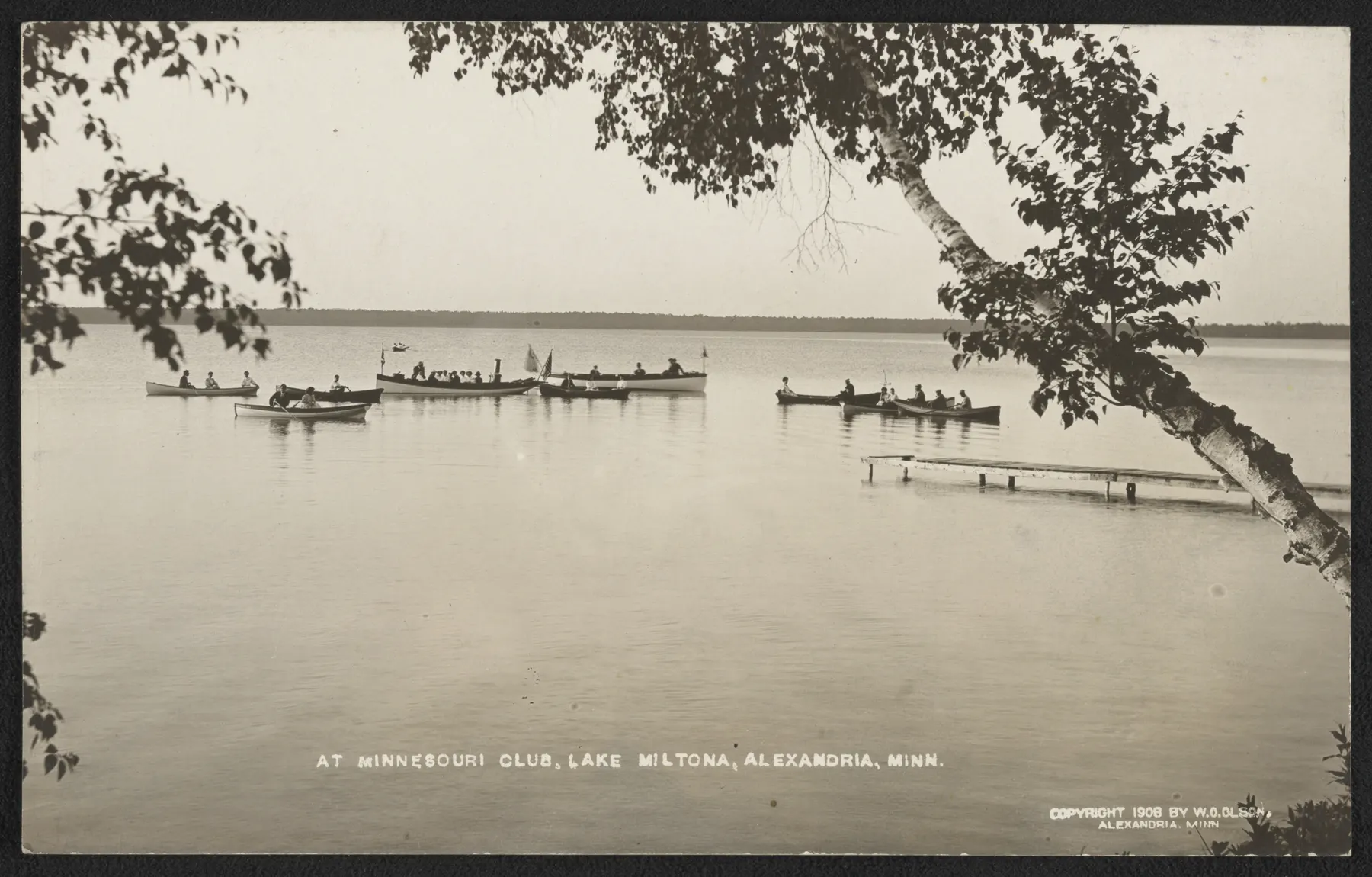
That is the part of the Minnesouri story the club's own history tends to skip. The club was founded in 1890, when 20 men from Missouri and 15 from Minneapolis bought 40 acres on Lake Miltona and incorporated an angling club, named by blending their two home states. Their charter promised "the instruction and mutual improvement in the art of angling and the social culture" of the members. Fine words. But a club like that runs on local hands, and the local hands stayed even longer than the members did.
The families who worked
Engfer was not the only lifer. Alfred Schulke spent 59 years employed by the Minnesouri as a fishing guide. Fifty-nine years of mornings on the same water, through the club's founding generation, two world wars, and the whole motor age arriving at the dock. Between Engfer's 56 and Schulke's 59, two local men gave the club 115 years of work. The members came for three months at a stretch, as one Miltona Township farmer put it at the time, and spent thousands of dollars with the merchants. The guides and caretakers were here for all of it, every season, and then they wintered with the place too.
The staff was a small town of its own. Edna Berglund, a first-grade teacher at Washington School in Alexandria, ran the dining room as hostess for many summers. Kori, who sang and played keyboards at the dinner hour, remembers the adults coming in to eat in formal black-and-white attire, a dining room dressed for dinner at the end of a day spent in boats. One commenter's grandmother cooked there in the 1950s. Pat waitressed in the summers of 1968 and 1969. Wilbert and Bob, a father and son, were the club's electricians. These names survive because their grandchildren and neighbors typed them into the comments under a Douglas County Historical Society photograph, which is where a working family's history usually lives: in memory, passed down, until somebody writes it down.
Gene and Lydia Hagedorn worked the club as a couple, he guiding, she keeping house. Their granddaughter Cheryl remembers what happened after the fishing. Her grandfather would clean the clients' catch and fry a meal of fish for them over an open fire, in a huge frying pan. The family still has the pan. Sit with that detail a moment. The boats are gone, the clients are gone, the guide is gone, and the pan is still in the family, which means the story gets told every time somebody lifts it. That is how the MAC's history actually survived: not in a clubhouse archive, but in kitchens and comment threads, carried by the grandchildren of the people who did the work.
The families who summered
The member families kept the same rhythm from the other side of the dining room.
Debby Noah Lawrence was a fourth-generation member of the Minnesouri Angling Club. Her obituary says it plainly: her family's cottage at Lake Miltona "has been in the family for more than 100 years." Each summer she looked forward to seeing what the obituary calls her "life-long summer friends," and her fondness for Miltona and the club "was passed down to her children and grandchildren." Count the generations in that one cottage. Somebody's great-grandparents bought into a bass club in the age of the Monmouth catch logs. Their children summered there. Their grandchildren summered there. And Debby, the fourth generation, handed the same summers to a fifth and sixth.
Dick Owen's line into the club started the way a lot of these stories start, with two kids and a long evening. He met Virginia "Ginger" McCord at the Minnesouri when both of them were 15. He grew up to run steel companies in Fargo, Wichita, and Kansas City, and to serve as president of the club where he had been a teenage summer kid. In retirement, his obituary says, Dick and Ginger "continued to enjoy summers at the MAC Club where they met," first with their two daughters, and later with their grandchildren. He had met a girl there at 15; he ended up presiding over the club, and then watching his grandchildren grow up on the same shore.
Gregg, commenting on a historical society photo of the club, summed up the membership policy in one dry line: "You had to be born into that club." He meant it as a joke about exclusivity, and it lands as one. But read it against the Engfers and the Hagedorns and the Lawrences and the Owens, and it is also just the literal truth, in both directions. The members were born into it. So were the caretaker's daughters. So was the guide's granddaughter, who inherited the pan and the story that goes with it. Four generations at the MAC is not a figure of speech. It is the club's actual structure, on both sides of the dining room door.
What is left
The club is still there. It runs today as the Minnesouri Association of Cottages, a private club of more than 100 members, and the summers continue: members' children grow up on the same shore their great-grandparents fished, and local families still staff the place. The bass that started all of it are still in the lake, along with the walleye and muskies that made Miltona famous in later chapters.
See it yourself: drive Minnesouri Club Road along the shore where the cottages stand behind the trees, admire the club from the water the way its first guests saw it, and stop at the Legacy of the Lakes Museum in Alexandria, where a re-created Minnesouri front porch lets you stand in the club's world without crossing its gate. The lake itself is public, all 5,731 acres of it. The families are still coming. Some of them have been coming since 1890.
Spot an error? Read our corrections policy.