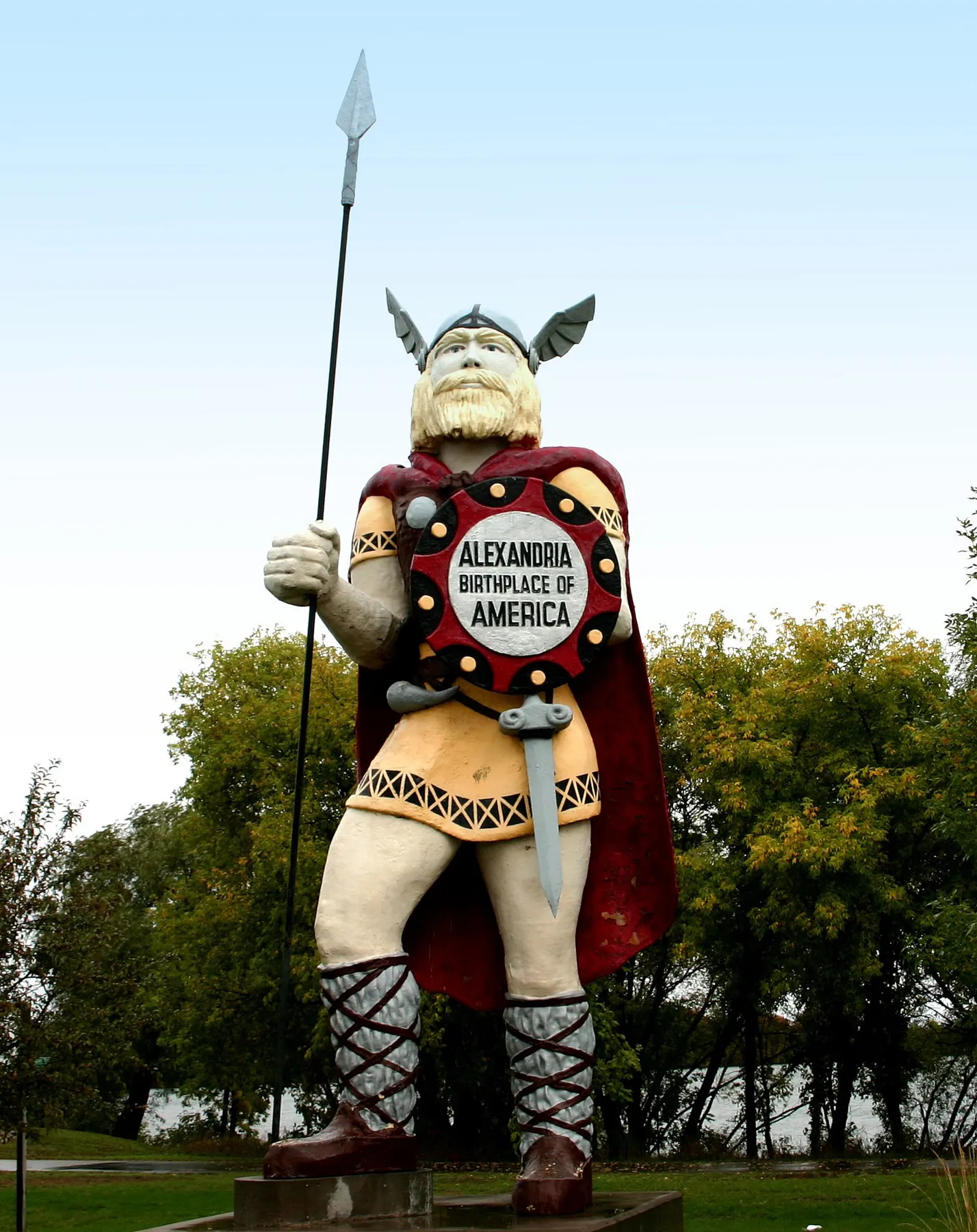
He rode east on a special trailer in the spring of 1965, all 28 feet and four tons of him, to stand guard at the New York World's Fair.
Most town mascots start at home. Big Ole started in New York.
The New York World's Fair had opened in 1964 to thinner crowds and thinner receipts than its promoters promised, and when it reopened for its second season in 1965 it wanted exhibits with more pizzazz. Alexandria, Minnesota, answered with a Viking.
The plan had been building since January 1964, when the North Star World's Fair Corporation of Osseo, Minnesota, began work on an addition to the Minnesota pavilion. The display was called "Minnesota, Birthplace of America," and its centerpiece was the Kensington Runestone, the rune-carved stone that farmer Olof Ohman had dug up near Kensington in 1898. The stone's inscription told of Norse explorers passing through the area in 1362, and Alexandria had built its identity on that claim. What the display needed was a greeter nobody could walk past.
Fiberglass sculptor Gordon Schumaker, working as Gordon Displays of Minneapolis, built him, and the statue was finished in April 1965. Schumaker was the right hire. He had already made the big Smokey Bear in International Falls and the big bluegill in Orr. Ole was the biggest of the three: 28 feet tall, four tons of fiberglass and steel, horned helmet on his head and a shield on his arm lettered with the display's claim.
It took a special trailer to haul a 28-foot, four-ton Viking from Minneapolis to New York, and he arrived in time for the fair's reopening on April 21, 1965. The Alexandria Chamber of Commerce's written history of the statue says that in two days, over 250,000 fairgoers viewed him. He stood at the Minnesota pavilion beside the Runestone display, an animated scene built around the stone, while the crowds filed past. Not everyone back home cheered the stunt. Roadside America, which keeps Ole's unofficial biography, notes that Minnesota's governor opposed the Viking statue. The fairgoers did not seem to mind.
When the fair's second season ended, Ole came home. On December 21, 1965, the statue arrived in Alexandria and was erected on a traffic island at the north end of Broadway, where he towered over most of the buildings in town. He has stood watch over Alexandria ever since, pronounced OH-lee, and the town has spent sixty years patching him up.
The patching started early. For the holidays in 1967 the town dressed him in a Santa suit, and someone shot a flaming arrow into the suit and set him on fire. The repairs cost about $3,000. Vandals snapped his sword off, more than once, and each restoration brought the sword back a little shorter than the one before. Cars kept crashing into him on his island in the middle of the intersection. On August 21, 1980, he was moved back from the intersection of County Road 82 and Broadway to make room for a new stoplight and to get him out of the traffic's way, and the Department of Transportation paid for the move.
The worst of it came in 1996, when a freak windstorm knocked him cockeyed. While he lay on his back waiting for repairs, the snow-loaded roof of the building storing him collapsed and crushed his leg. A storm in 2014 blew off one of his helmet wings. In 2015, workers found a family of birds living in his shoulder. Every round of repairs came with a repaint, and his beard has changed color with the decades, gray to brown to yellow to rusty red, while his cloak went from yellow to scarlet.
In 2002 he moved again, a couple of blocks north to a small park on the south shore of Lake Agnes, at the head of the Central Lakes Trail and across from the Runestone Museum. It was a quieter post, and he needed it. An inspection in 2015 found cracks throughout his body, and Alexandria raised more than $26,000 to restore its 50-year-old Viking. Through most of 2016 he underwent structural repairs and got a new coat of paint, and the makeover was completed in August of that year. His sword was extended back to nearly its original length, and his beard came out red, the color it still wears.
His shield tells the story of the whole trip in one edit. At the fair it carried the display's broad claim, "Minnesota, Birthplace of America." Today it reads "Alexandria, Birthplace of America." The argument underneath those words, whether Norse explorers really carved the Kensington stone in 1362 or whether the stone is a later creation, has run for more than a century and belongs to its own story. Ole's job was never to settle it. His job was to stand next to the stone in New York, 28 feet tall, and make a quarter of a million people stop and look. He did the job, and then he rode home to Broadway.
He turned 60 in 2025, and the Runestone Museum Foundation looks after him now. On any summer day there is a short line of people waiting to stand under the shield and have their picture taken, which is what he was built for in the first place.
Big Ole stands in Big Ole Central Park at the north end of Broadway in Alexandria, on the south shore of Lake Agnes, across the street from the Runestone Museum. He is an easy drive from Lake Miltona, and the photo takes two minutes.
Spot an error? Read our corrections policy.